DNC Registry Data Book Reveals Key Trends for 2025
Explore the latest insights from the FTC's National DNC Registry Data Book for 2025. Despite a significant drop in complaints since 2021, robocalls still dominate. Learn about emerging threats, trends, and regional shifts in telemarketing strategies.
DNC Registry Data Book Reveals Key Trends for 2025
The Federal Trade Commission (FTC) recently released the National Do Not Call Registry Data Book for Fiscal Year 2025(“Data Book”). The most recent numbers reveal significant shifts in consumer protection over the past five fiscal years, with total complaints dropping by nearly 50% since their 2021 peak while active DNC registrations continued steady growth to over 254 million phone numbers.
What is The National DNC Registry Book?
The FTC began publishing the annual DNC Registry Data Book in 2012 to document the DNC’s activity and effectiveness. The Data Book now serves multiple critical functions for the FTC and the broader consumer protection ecosystem. It provides detailed aggregate data on three core aspects of the National Do Not Call Registry:
1. Phone Numbers on the Registry: Statistics on active registrations, demographic breakdowns by state, and registration trends over time
2. Telemarketer and Seller Access: Information about organizations accessing the Registry, including the number of entities paying for expanded access and those using exemptions
3. Consumer Complaints: Comprehensive data on complaints filed by consumers, broken down by complaint topic (reducing debt, imposters, medical scams, etc.), call type (robocalls vs. live callers), and geographic location
Beyond internal FTC reporting, the Data Book serves multiple stakeholder communities, including law enforcement, policy makers, researchers, consumers, and technology companies that service the telecommunications ecosystem, which use the published complaint data to refine their filtering algorithms.
Active DNC Registrations: Sustained Growth
The National Do Not Call Registry has demonstrated consistent expansion since its 2003 inception, adding approximately 17 million active registrations between FY 2020 and FY 2025—a compound annual growth rate of 1.4%.
Active Registrations by Fiscal Year (as of September 30):
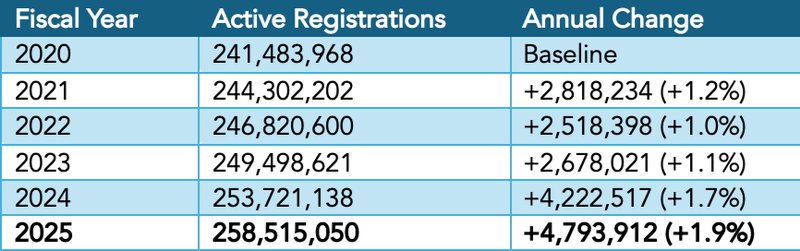
The FY 2025 increase of 4.8 million registrations represents the largest single-year growth in the six-year period and a 1.9% year-over-year increase, suggesting heightened consumer awareness and continued demand for telemarketing protection
Total Complaints: Surprising Rebound After Historic Low
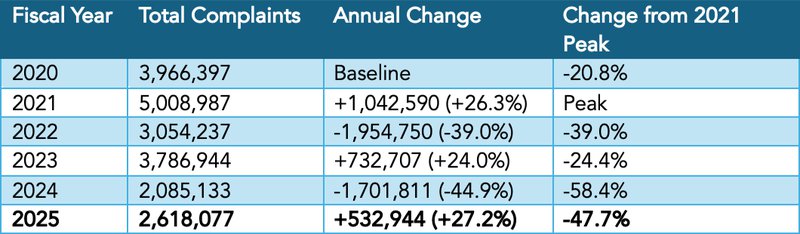
The most striking trend across the six-year period is the volatile trajectory of consumer complaints, which surged to a record high in FY 2021, plummeted through FY 2024, then rebounded significantly in FY 2025.
Total DNC Complaints by Fiscal Year:
Robocalls vs. Live Calls: Continued Evolution
The composition of complaints continued to shift in FY 2025, with robocalls maintaining their dominance as the primary complaint driver.
Complaints by Call Type (FY 2020-2025):
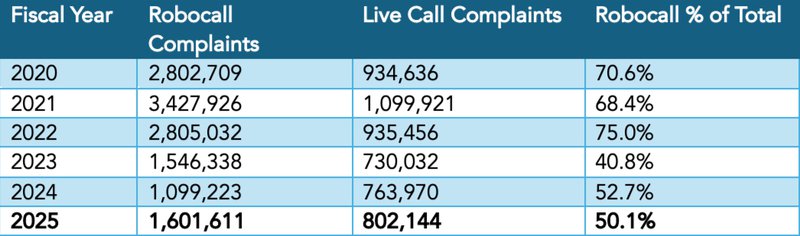
The breakdown for FY 2025 indicates that robocalls continue to account for a slim majority of complaints—approximately 50%—with live caller complaints comprising roughly 33% and unreported call types making up the remainder. This represents a stabilization after the dramatic fluctuations seen between FY 2022 and FY 2024
Top Complaint Topics: Debt Reduction Surges to #1
The nature of telemarketing has long reflected overall economic trends throughout the country, a fact reflected in the data for FY 2025, with debt reduction complaints suddenly surging to the top complaint category for the first time. Total debt reduction complaints for FY 2025 far surpassed medical & prescriptions and imposter complaints, the two top categories in FY 2024.
FY 2025 Top Complaint Topics:
1. Reducing Debt: 446,243 total complaints—a dramatic increase and the new leader
2. Imposters: 246,228 total complaints—remaining a persistent threat
3. Medical & Prescriptions: 208,228 total complaints
4. Energy, Solar & Utilities: 35,378 total complaints
5. Home Improvement & Cleaning: 28,571 total complaints
Key Trends from FY 2020-2025:
The debt reduction category experienced explosive growth in FY 2025, representing approximately 17% of all complaints and far exceeding all other categories. This surge likely reflects increased consumer financial stress, inflation concerns, and scammers exploiting economic uncertainties.
Imposter complaints, while remaining in the top two, declined significantly from their FY 2021 peak of nearly 500,000 to 246,228 in FY 2025—a 50% reduction over four years. Despite this decline, imposter scams continue to represent approximately 9-10% of all DNC complaints.
Medical and prescription-related calls maintained their position as a top three concern with 208,228 reports in FY 2025, representing about 8% of total complaints and highlighting persistent healthcare fraud schemes.
The shift from imposter-dominated complaints (FY 2021-2023) to debt-reduction-dominated complaints in FY 2025 suggests scammers are adapting tactics in response to enforcement actions and changing economic conditions.
State-by-State Rankings: Western and Southern States Lead Complaints
Registration rates and complaint patterns continued to vary considerably by geography in FY 2025, with notable shifts in state rankings.
Top 5 States by Active DNC Registrations per 100,000 Population (FY 2025):
1. New Hampshire: Highest registration rate (maintaining #1 position from prior years)
2. Connecticut: Second-highest registration rate
3. Vermont: Third-highest registration rate
4. Massachusetts: Fourth-highest registration rate
5. Kansas: Fifth-highest registration rate
These northeastern and plains states consistently led registration rates throughout the six-year period, suggesting stronger consumer awareness or greater concern about telemarketing intrusions in these regions.
Top 10 States by DNC Complaints per 100,000 Population (FY 2025 - Official FTC Data):
1. Arizona: 1,028 complaints per 100K—highest complaint rate nationally
2. Tennessee: 1,017 complaints per 100K
3. Nevada: 960 complaints per 100K
4. Illinois: 943 complaints per 100K
5. Florida: 933 complaints per 100K
6. New Jersey: 885 complaints per 100K
7. North Carolina: 872 complaints per 100K
8. Ohio: 850 complaints per 100K
9. Maryland: 834 complaints per 100K
10. California: 820 complaints per 100K
The FY 2025 state rankings show significant geographic shifts, with Arizona rising to the top position for the first time and Tennessee entering the top five. Western and southern states now dominate the complaint rankings, replacing the previous pattern where Delaware and Ohio typically led.
This geographic shift may reflect changing scam targeting strategies, with fraudsters focusing on states with growing retirement populations, military communities, or specific economic vulnerabilities.
Organizations Accessing the DNC: Modest Growth
The number of telemarketers and sellers accessing the DNC Registry fluctuated over the six-year period before showing growth in FY 2025.
Organizations Accessing the Registry by Fiscal Year:
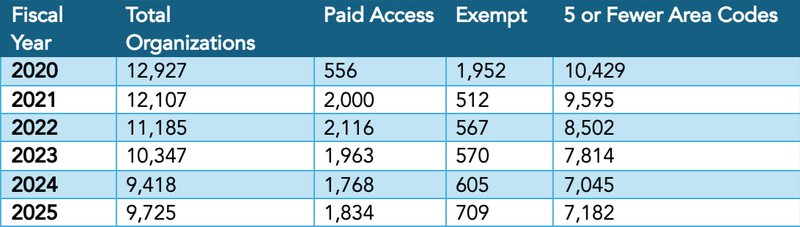
Organizations accessing the DNC Registry rebounded significantly in FY 2024-2025 after declining through FY 2022, potentially reflecting renewed legitimate telemarketing activity or improved compliance efforts.
Emerging Threats: AI, Debt Relief Scams, and Economic Exploitation
The FY 2025 data highlights several emerging patterns requiring regulatory attention:
- Debt Relief Scam Explosion: The 446,243 debt reduction complaints in FY 2025 represent an unprecedented surge, suggesting scammers are exploiting economic anxiety, inflation concerns, and consumer debt burdens. This category’s dominance marks a significant tactical shift from imposter scams toward financial desperation exploitation.
- AI and Voice Cloning: While not yet fully quantified in complaint categories, the FTC has identified AI-generated calls and voice cloning as rapidly evolving threats requiring new technological and regulatory countermeasures.
- Geographic Targeting: The rise of Arizona, Tennessee, and Nevada in complaint rankings suggests scammers may be targeting specific demographic groups (retirees, military communities) or exploiting regional economic vulnerabilities.
The Overall Picture
The National Do Not Call Registry data for FY 2020-2025 tells a story of significant progress punctuated by persistent challenges. Active registrations grew steadily to 258.5 million phone numbers, while total complaints declined 48% from their FY 2021 peak despite rebounding 25% in FY 2025.
The dramatic shift from imposter-dominated complaints to debt-reduction scams signals evolving fraud tactics exploiting economic pressures. Geographic variations intensified, with western and southern states experiencing disproportionately high complaint rates. Robocalls, while declining significantly from their peak, continue to account for the majority of violations.
The data demonstrates that aggressive enforcement targeting upstream infrastructure providers, combined with expanded regulatory authority and emerging technology protections, has yielded measurable consumer protection gains. However, the FY 2025 complaint increase serves as a reminder that illegal telemarketing remains a persistent threat requiring continued vigilance, adaptation, and enforcement.
For consumers, the Registry remains a valuable tool, with complaints informing targeted enforcement actions. For telemarketers, the data underscores that violations carry real consequences and regulatory scrutiny continues to intensify. The battle against unwanted calls is far from over, but the six-year trend shows meaningful progress in protecting American consumers.
Recent Posts
TOPICS